
 Job Seekers
 Resources
 Timesheets
 Submit a CV
 Login
Login Temporary Staffing Solutions
 Permanent Recruitment Solutions
 Executive Search
 Payroll Services
 Modular Recruitment Services
 Employer Resources
 HR Services
 WHS Consulting
 Outplacement / Career Transition
 Accounting and Finance
 Business Support
 Community Services
 Customer Service
 Engineering
 Events and Exhibitions
 Government
 Healthcare
 Labour Hire
 Manufacturing
 Not-for-profit
 Sales and Marketing
 Warehousing and Logistics
 About us
 Meet the Team
 Blog
Blog Community
 Join the Team
 Candidate Timesheet
and Portal Information
Candidate Timesheet
and Portal Information Submit Timesheets
 Blog
Blog Join the Team
 Payroll Services
 Timesheets
 Customer Service
 Engineering
 Warehousing & Logistics
Australian Labour Market August 2026: What the Latest Hiring Trends Mean for Employers

Job ads have risen for three consecutive months, yet 45% of employers still report difficulty recruiting and unemployment has climbed to 4.5%. For Australian employers, that combination is the real story of the labour market heading into Q4 2026.
New demand is also emerging. Christmas hiring is already building, data-centre investment is creating jobs across technology and engineering, and AI is increasingly appearing not only in job advertisements but in job titles themselves.
The question for employers isn’t whether the market is getting stronger or weaker — it’s where demand is growing, which skills are becoming harder to find, and how fast workforce requirements are shifting.
Is hiring activity picking up in Australia?
SEEK’s August Employment Report shows Australian job ads increased 0.5% month-on-month, marking the third consecutive monthly increase. Manufacturing, Transport & Logistics job ads increased 1.3%, while Trades & Services increased 1.0%.
However, the recovery is not consistent across the country. Victorian job ads fell 1.3% in September, while New South Wales and Queensland recorded their third consecutive monthly increases. SEEK also reports that applications per job ad increased 0.7% in August, indicating that candidate competition remains significant even as job advertising rises.
This creates a more nuanced recruitment environment for employers.
More job advertisements do not necessarily mean that every employer will find it easier to recruit. Candidate availability, location, skills requirements and the type of role being filled all influence the recruitment process.
For businesses in manufacturing, logistics, warehousing, engineering and trades, these differences can be particularly important when planning workforce requirements.
State & Territory Hiring Trends Across Australia
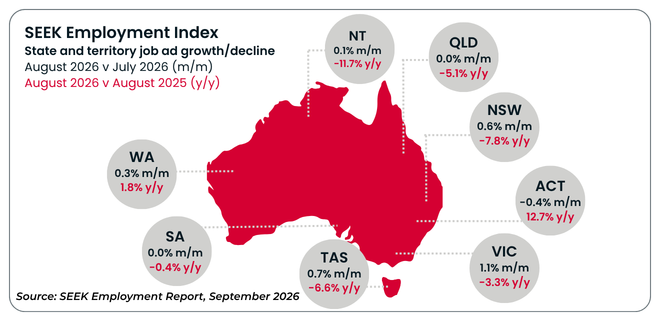
Victoria led Australia for growth in job ad volumes in August, with ads up 1.1% from July, the strongest monthly increase in more than four years. Growth was broad-based, with notable increases across Hospitality & Tourism, Trades & Services, and Manufacturing, Transport & Logistics.
This aligns with what we’re seeing across our Victorian client base, particularly in warehousing, logistics, manufacturing and trades. Demand for reliable, job-ready workers remains strong, with labour hire and temporary staffing helping employers respond quickly when they need additional people. We’re also seeing experienced candidates with the right licences and skills move quickly when suitable roles become available.
NSW also recorded its strongest monthly growth since mid-2022, while Tasmania saw more modest growth across Trades & Services, Hospitality & Tourism and Healthcare & Medical.
Western Australia was the only state to record annual growth in job ad volumes, up 1.8% year-on-year, driven by continued growth in Mining, Resources & Energy and Manufacturing, Transport & Logistics.
Queensland and South Australia were relatively flat month-on-month, while job ad volumes continued to decline in the ACT and Northern Territory.
For employers, the picture remains mixed across Australia. Demand isn’t moving in the same direction everywhere, but where hiring activity is increasing, competition for experienced and job-ready workers can be significant.
For businesses looking for labour hire, temporary staff or workforce solutions, understanding what is happening in your local employment market can help you plan ahead and respond to changing workforce needs.
Are employers still struggling to recruit?
The latest Jobs and Skills Australia Recruitment Experiences and Outlook Survey reinforces this mixed picture.
In August 2026, 50% of employers reported that they were recruiting, while 45% experienced difficulty recruiting. A further 20% expected to increase their staffing levels.
That means recruitment remains an active issue for a significant proportion of Australian employers.
The challenge is not necessarily a lack of people in the labour market overall. It can be a mismatch between the people available and the skills, experience, location, availability or working arrangements employers require.
This is particularly relevant for businesses recruiting into operational and specialist roles where vacancies can have an immediate impact on productivity, customer service and workforce capacity.
What does the ABS data show about unemployment in 2026?
The latest Australian Bureau of Statistics (ABS) Labour Force data also points to a labour market that is changing rather than moving in one clear direction.
In July 2026, employment decreased by around 16,000 people to 14.8 million in seasonally adjusted terms. The unemployment rate increased to 4.5%, while the underemployment rate was 6.4%. Participation also edged down to 66.9%.
The ABS data needs to be considered alongside other labour-market indicators. Job advertising is measuring employer demand for workers, while the Labour Force Survey measures employment, unemployment and participation.
Together, the data shows why employers should avoid relying on a single headline measure when making workforce decisions.
The labour market can be softer overall while particular industries, occupations or locations continue to experience recruitment pressure.
Christmas hiring is already building
Seasonal workforce planning is also starting earlier.
Indeed reports that, at the end of August, 1.8% of Australian job postings mentioned Christmas in the job title, compared with 1.0% at the same time last year. Jobseeker searches for Christmas-related work also increased, with 1.4% of searches related to Christmas jobs compared with 1.3% a year earlier.
Christmas demand is concentrated in retail, but the workforce impact extends much further.
More retail activity creates additional demand for warehousing, pick packing, transport, delivery, customer service and other operational roles. Hospitality and tourism can also see increased demand as Christmas approaches.
For employers relying on temporary or seasonal workers, early planning can be important. Recruitment, screening, onboarding and workforce scheduling all take time, particularly when large numbers of workers are required.
Forklift drivers remain in demand
Forklift drivers are a good example of how recruitment challenges can sit beneath broader labour-market numbers.
Horner is already seeing strong demand from clients for experienced forklift drivers, particularly across warehousing, logistics and manufacturing. Finding candidates with the right experience, availability and workplace fit can be challenging, especially when employers need workers who can step into a role quickly.
Jobs and Skills Australia estimates around 71,300 people are employed as forklift drivers across Australia. The occupation is concentrated in Transport, Postal & Warehousing, Manufacturing and Wholesale Trade. Victoria accounts for 31.3% of forklift-driver employment, followed by NSW at 27.7% and Queensland at 20.3%.
There is also a longer-term workforce issue.
Research by Oxford Economics Australia for the Australian Food and Grocery Council found that around 60% of the current forklift-driver workforce is expected to leave through retirement and other natural attrition by 2035. The research projects demand to exceed workforce supply for forklift drivers in food and grocery manufacturing by 2035.
For employers, the challenge is not simply filling today’s vacancy. Experienced operators are essential to keeping warehouses, distribution centres and manufacturing operations moving, while the workforce needs to keep pace with future demand.
For businesses with recurring forklift requirements, building a reliable candidate pipeline rather than recruiting only when a vacancy becomes urgent can help reduce pressure when demand increases.
Data centres are creating new demand beyond technology
Another emerging area of workforce demand is Australia’s growing data-centre sector.
Around 1% of Australian job postings mentioned data centres in August, approximately twice the level seen two years ago according to the Indeed Hiring Lab’s latest blog. Jobseeker searches for data-centre roles have increased by around 160% since December last year.
Importantly, this is not simply a technology recruitment story.
Indeed’s data shows data-centre job postings include management, installation and maintenance, electrical engineering and industrial engineering, alongside IT infrastructure and software development.
The majority of data-centre-related postings are therefore not necessarily for traditional technology roles.
For employers and recruitment businesses, this highlights how investment in emerging industries can create workforce demand across a much broader range of occupations.
It also reinforces the importance of understanding where investment is occurring and which supporting skills will be required as projects develop.
AI is changing the skills employers are looking for
AI is another area where the language of recruitment is changing.
According to SEEK, AI skills appeared in 2.3% of Australian job advertisements in August, up 66.2% year-on-year. References to Agentic AI increased 185.3%.
The change is not limited to job descriptions.
Indeed reports that the number of Australian job titles mentioning AI has more than tripled over the past year. While technology roles still account for the majority of these AI-related titles, AI is increasingly appearing across other occupations, including sales, management and education.
This is an important distinction for employers.
AI is not necessarily creating an entirely new job every time it appears in a job advertisement. In many cases, existing roles are evolving as AI tools become part of the work.
That means workforce planning increasingly needs to consider not just which roles a business needs, but how the skills required within those roles are changing.
For employers, this could mean assessing whether AI capability needs to be recruited externally, developed within existing teams or incorporated into existing roles.
What does this mean for workforce planning?
The latest data points to a labour market where timing and workforce planning remain important.
Employers are dealing with several different forces at once:
- Job advertising is increasing in parts of the market.
- Recruitment difficulty remains high for many employers.
- Candidate competition varies by industry and location.
- Seasonal hiring is already building ahead of Christmas.
- Data-centre investment is creating demand across technology, engineering, maintenance and other occupations.
- AI is increasingly appearing in job advertisements and job titles.
- Workforce requirements are changing as businesses adopt new technologies.
For employers, waiting until a vacancy becomes urgent can make recruitment more difficult, particularly where skills are specialised or candidate supply is limited.
Workforce planning does not necessarily mean recruiting immediately. It means understanding upcoming demand, identifying potential skills gaps and allowing enough time to attract, assess and onboard the people required.
For organisations heading into the final quarter of 2026, that planning becomes particularly important as seasonal demand, project requirements and changing skills needs begin to overlap.
What should Australian employers consider when hiring in 2026?
There is no single labour-market trend that applies to every employer.
Businesses should consider:
What roles will we need over the next three to six months?
Look beyond current vacancies and consider seasonal peaks, projects, growth and expected turnover.
Which skills are becoming harder to find?
Identify roles where recruitment is consistently taking longer or where candidate availability is limited.
Can we build the skills internally?
AI and other emerging capabilities may be incorporated into existing roles rather than requiring entirely new positions.
Where could temporary, labour hire or contract staff help?
Flexible staffing can help businesses respond to seasonal demand, projects, absences or short-term increases in workload.
How early should we start recruiting?
For high-volume or specialist recruitment, allowing additional time for sourcing, screening and onboarding can reduce pressure later.
What does the Australian labour market mean for employers?
The latest data suggests Australian employers are operating in a labour market that is neither uniformly tight nor uniformly soft.
Demand is increasing in some sectors, recruitment difficulties remain, and new sources of workforce demand are emerging. At the same time, unemployment has risen slightly and job-market conditions vary between states and industries.
For employers, the focus should therefore be on their specific workforce requirements rather than the headline labour-market number alone.
Understanding demand, skills availability and timing can help businesses make better-informed workforce decisions as they move through the final quarter of 2026.
Recruitment and labour hire support across Australia
Recruitment requirements can vary significantly between locations, industries and workforce types.
As a recruitment agency supporting employers across Australia from Melbourne, Brisbane, Sydney and beyond, Horner provides recruitment solutions tailored to local workforce requirements.
Whether an employer needs additional workers for a seasonal peak, specialist skills for an ongoing vacancy or flexible labour for a project, workforce requirements need to be considered in the context of the local labour market.
Horner works with employers across temporary staffing, labour hire, contract and permanent recruitment, with experience across warehousing and logistics, manufacturing, engineering and trades, business support, local government and NFP sectors.
Talk to Horner about your workforce requirements for Q4 and beyond.
Frequently Asked Questions (FAQ)
What is happening in the Australian labour market in 2026?
Australia’s labour market is showing mixed conditions. SEEK reported three consecutive months of growth in job advertising through September, while the ABS reported an unemployment rate of 4.5% in July. Recruitment difficulty also remains significant, with 45% of employers reporting difficulty recruiting in August.
Are Australian employers still hiring?
Yes. Jobs and Skills Australia reported that 50% of employers were recruiting in August 2026, while 20% expected to increase staffing levels.
Which industries are hiring in Australia in 2026?
Hiring conditions vary by industry. SEEK reported growth in September job ads for Manufacturing, Transport & Logistics and Trades & Services. Seasonal demand is also increasing across areas such as retail, transport and logistics ahead of Christmas. Data-centre investment is creating additional demand across technology, engineering, maintenance and management roles.
Are skilled workers still in short supply in Australia?
Recruitment difficulty remains an issue for many employers. Jobs and Skills Australia reported that 45% of employers experienced difficulty recruiting in August. The level of difficulty varies by occupation, industry, location and the skills required.
How is AI changing recruitment in Australia?
AI is increasingly appearing in Australian job advertisements and job titles. SEEK reported AI skills in 2.3% of Australian job ads in August, up 66.2% year-on-year, while Agentic AI references increased 185.3%. Indeed also reports that the number of Australian job titles mentioning AI has more than tripled over the past year.
When should businesses start Christmas recruitment?
Christmas recruitment can begin well before the peak December period. Indeed reported that 1.8% of Australian job postings mentioned Christmas in the job title at the end of August, compared with 1.0% a year earlier. Employers requiring large temporary workforces should allow time for sourcing, screening, onboarding and rostering.
What is driving demand for data-centre workers in Australia?
The expansion of data-centre infrastructure is creating demand for a broad range of workers. Indeed reports that data-centre-related job postings account for around 1% of Australian job postings, with roles spanning IT, management, installation and maintenance, electrical engineering and industrial engineering.
How can Australian businesses prepare for changing workforce needs?
Businesses can start by identifying upcoming workforce requirements, assessing skills gaps, considering permanent versus temporary staffing needs and allowing sufficient time for recruitment and onboarding. Workforce planning is particularly important where demand is seasonal, project-based or dependent on specialised skills.
Sources: SEEK Employment Report, September 2026; Jobs and Skills Australia, August 2026; Australian Bureau of Statistics, Labour Force, July 2026; Indeed Hiring Lab, September 2026; Oxford Economics Australia, Workforce pressures facing the food & grocery manufacturing sector, May 2026, commissioned by the Australian Food and Grocery Council.
Related blog posts
View all posts
2025 SEEK Annual Recruitment Awards (SARAs) Finalist!
Horner is a SEEK Annual Recruitment Awards (SARAs) finalist! We’re thrilled and proud to share t...
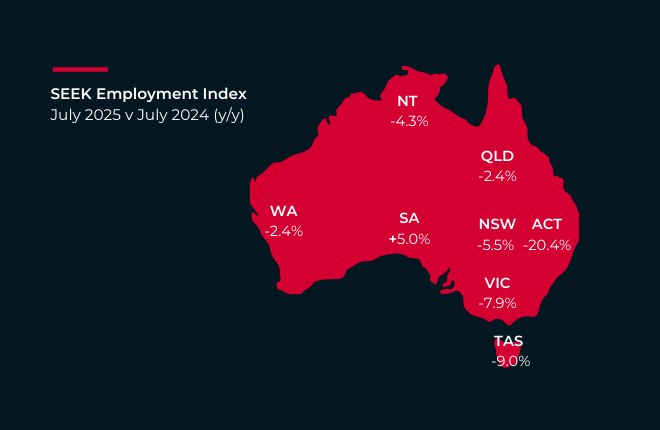
Employment Trends – July 2025
Snapshot of the latest employment trends for July 2025: The unemployment rate remains steady at 4.2%...
2025 Recruitment & Staffing Industry Census
Your voice is important – have your say in the 2025 Recruitment & Staffing Industry Census...